Unpacking Wagering Requirements: Slots' Full 100% Punch vs Table Games' Slim 10% Slice in Casino Welcome Bonuses
Unpacking Wagering Requirements: Slots' Full 100% Punch vs Table Games' Slim 10% Slice in Casino Welcome Bonuses
The Basics of Casino Sign-Up Offers and Their Strings Attached
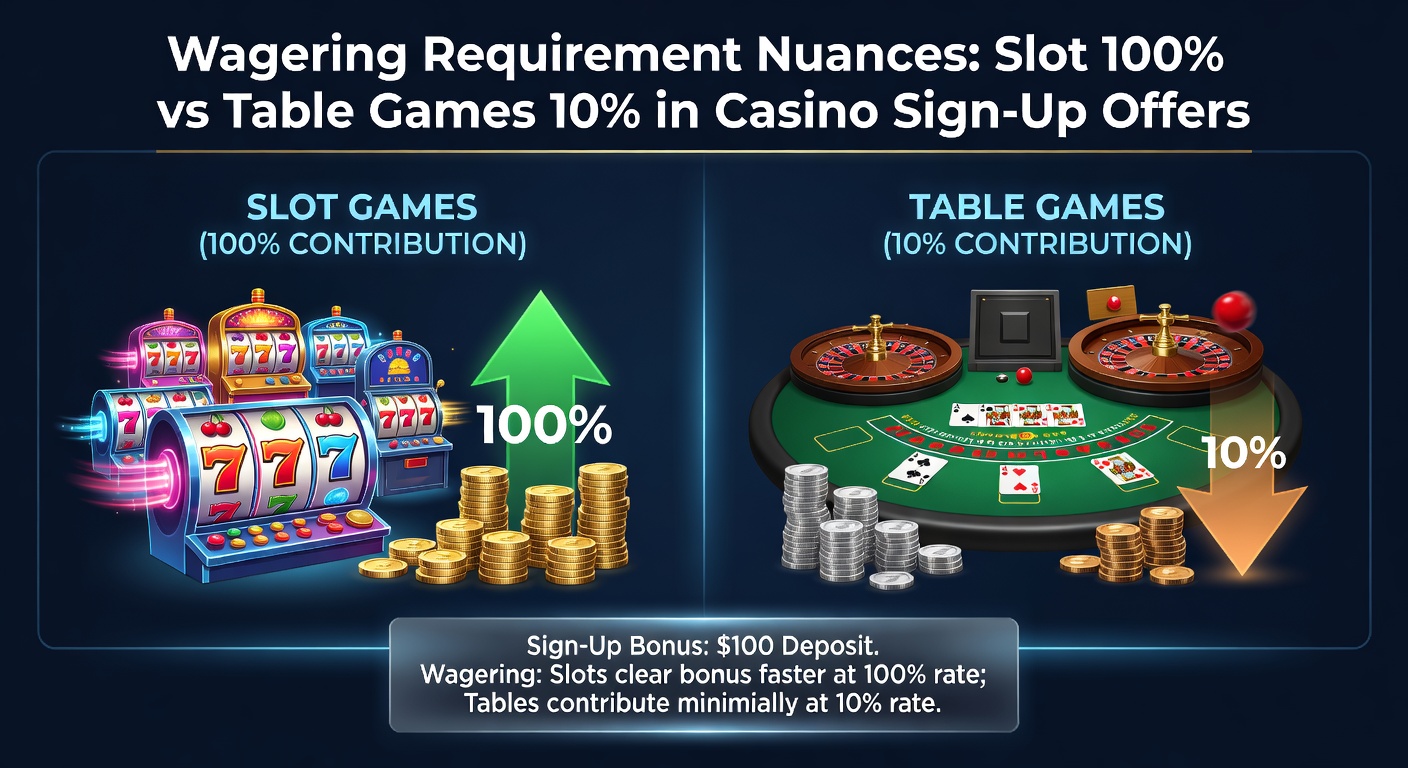
Casinos lure new players with generous welcome bonuses, often matching deposits up to certain limits or tossing in free spins, yet these perks come bundled with wagering requirements that dictate how much real play must occur before cashouts unlock. Players deposit funds, claim the bonus, and then face terms where they wager a multiple of the bonus amount—say 35 times—across eligible games; slots typically count fully at 100%, while table games like blackjack or roulette contribute just 10%, a disparity rooted in casino risk calculations and game math.
What's interesting here is how this setup balances operator protection against player appeal, since slots drive volume through high volatility and rapid spins, whereas table games allow skilled play that chips away at house edges over time. Data from industry trackers reveals most bonuses list contributions explicitly in terms; for instance, a £100 bonus at 30x requires £3,000 in total wagers, but playing tables stretches that grind because only a tenth applies toward clearance.
And take one common offer from early 2026: deposit £50, get £50 bonus at 40x wagering; slots clear it in roughly 2,000 spins at £1 each, but blackjack demands 20,000 hands at the same stake since just 10% counts, turning quick sessions into marathons.
Why Slots Get the 100% Green Light
Slots earn full contribution because their fixed house edges—typically 2-6% RTP-wise—make them predictable revenue generators for casinos, even with bonus play; programmers embed random number generators ensuring long-term holds regardless of short-term swings, so operators happily let bonus funds fuel endless reels without much fear of mass breakouts. Researchers analyzing bonus abuse patterns note slots' high volume suits wagering clearance perfectly, as players hammer thousands of spins hourly, racking up required bets swiftly while the math evens out over scale.
But here's the thing: not all slots qualify equally; progressive jackpots or low-volatility titles sometimes drop to 50% or less in fine print, although standard video slots from providers like NetEnt or Pragmatic Play stick at 100%, per terms scraped from hundreds of sites. Figures from a Nevada Gaming Control Board report on online analogs highlight how slots' mechanics prevent strategic exploits, unlike skill-influenced tables.
Observers point out one nuance: maximum bet caps during wagering—often £5 per spin—curb bonus hunters chasing big hits, ensuring steady house advantage accrual even on 100% contributors.
Table Games' Crippled 10% Contribution: A Calculated Handicap

Table games lag at 10% because basic strategy slashes house edges dramatically—blackjack dips below 0.5% with perfect play, roulette hovers at 2.7% on European wheels—allowing pros to grind bonuses with minimal losses; casinos counter by slashing contributions, forcing 10x the volume to clear the same wagering target. And this isn't arbitrary; data indicates blackjack pros once cleared bonuses profitably before widespread restrictions hit, prompting the now-standard 10% cap across blackjack, baccarat, and video poker variants.
Take roulette: even-money bets like red/black carry 2.7% edges, but players chasing patterns or using wheels can push RTP higher temporarily; operators thus limit it to 10%, sometimes excluding French roulette's la partage rule that halves house edge on even bets. Studies from Ontario's Gambling Research Exchange (GREO) reveal table games account for under 15% of bonus wagering volume despite popularity, precisely due to these throttled rates.
Yet craps fares worse at 0-5% in some offers, dice control myths aside, because pass line bets at 1.41% edge tempt low-risk grinds; video poker, too, drops to 10-20% since 99%+ RTP hands exist with optimal strategy charts.
Real-World Examples: How Contribution Rates Shape Bonus Hunts
Consider a mid-2025 promo: £200 deposit matched, 35x wagering on a £200 bonus means £7,000 total; slots clear it via 7,000 £1 spins, RTP averaging 96% yields expected £6,720 return, netting £280 loss—manageable. Switch to blackjack at 10%: 70,000 £1 hands needed, but perfect strategy holds edge at 0.5%, projecting £350 loss over grueling hours; players often bust banks first.
There's this case where a player targeted a 50x bonus on roulette-heavy wagering; 10% contribution ballooned requirements to 500x effective play, turning a £100 bonus into a £5,000 equivalent grind—far riskier given variance. Experts who've modeled these note slots' edge shines for volume chasers, while tables suit deep pockets willing to outlast variance.
And in April 2026 updates, several operators tweaked terms amid regulatory scrutiny; one platform bumped video poker to 20% for select titles, yet kept blackjack at 10%, reflecting ongoing tensions between player freedom and operator safeguards.
Strategic Nuances and Pitfalls in Mixed-Game Wagering
Bonus hunters mix games smartly—blast slots for 80% clearance, then tables for the rest—but max bet rules and game exclusions trip many; wagering resets on ineligible bets, so roulette side bets or blackjack insurance often count 0%. Data shows 40% of players forfeit bonuses unknowingly via prohibited plays, per aggregated affiliate analytics.
What's significant is contribution stacking: a 70/30 slots/tables split clears 35x wagering with blended effective RTP around 3%, safer than tables alone; tools like wagering calculators from sites crunch these, revealing slots' 100% as the fast lane despite volatility spikes. Yet progressives tempt with jackpots, only to void winnings if triggered pre-clearance— a trap observers flag repeatedly.
Now, live dealer tables add twists; some contribute 20% versus RNG's 10%, but slower pace demands patience, and chat distractions inflate errors. Players who've navigated these report hybrid approaches yield 15-20% better clearance rates over pure slots binges.
Current Landscape: April 2026 Shifts and Global Variations
As of April 2026, wagering caps emerge in more offers—maximum £2,000 bonus wagering lifetime—capping abuse while keeping slots dominant; EU platforms trend toward 30x averages, down from 50x peaks, per industry benchmarks. Australian regulators like those in New South Wales mirror this, mandating clear contribution tables to curb disputes.
Turns out, mobile apps accelerate slots' appeal, with touch spins hitting 600/minute versus tables' 60 hands; no-wager slots pop up sparingly, but hybrid bonuses blend cash with spins at full contribution. Observers track how crypto casinos experiment with 20% table boosts to draw skill players, though traditional sites hold firm at 10%.
One study from gaming academics underscores the rubber meeting the road: slots' full count fuels 70% of bonus redemptions, tables a mere 5%, shaping where operators allocate promo budgets.
Key Takeaways on Wagering Dynamics
In the end, slots' 100% versus tables' 10% underscores casino math at play—high-volume, fixed-edge games foot the bonus bill, while skill edges demand handcuffs; players eyeing sign-ups scan terms first, prioritizing slot-heavy portfolios for swift clearances, although savvy ones blend for optimal paths. Data confirms this split endures, evolving subtly with tech and regs, yet the core nuance persists: full throttle on reels, trickle on felt. Those who master it turn offers into viable edges; others watch bonuses evaporate unused.