Positioning Mastery in Digital Poker Cash Games: How Late-Stage Decisions Shift Expected Values on Licensed Platforms
Positioning in digital poker cash games determines how much information players gather before committing chips, and this advantage grows pronounced during late-stage decisions on the turn and river. Licensed platforms record hand histories that reveal consistent patterns where players in late position extract higher expected values through refined betting lines and fold equity calculations. Data from regulated operators shows that river decisions alone account for significant portions of overall profitability shifts when position allows one to act last.
Core Mechanics of Late-Stage Positioning
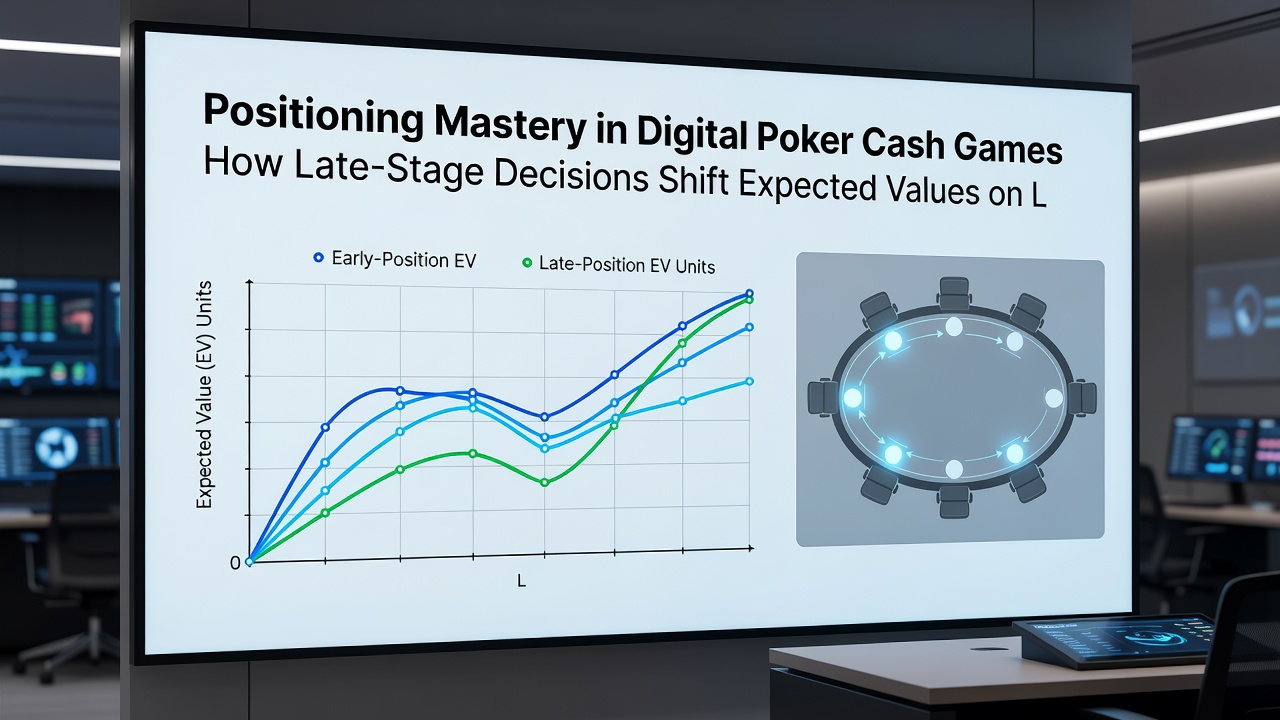
Players who act after opponents on final streets gain access to complete board texture information plus prior action frequencies, which directly alters pot odds and implied odds in real time. Research from poker analytics firms indicates that late-position river bets succeed at rates 8 to 12 percent higher than early-position equivalents across millions of tracked hands. This edge emerges because position permits delayed decisions until every variable, including opponent sizing tells and timing patterns, becomes visible.
Expected value formulas adjust accordingly when position is factored in. A player facing a river decision in position calculates fold equity against a narrower continuing range, while the same player out of position must commit without that information. Licensed platforms enforce identical rules across jurisdictions yet display measurable differences in player performance metrics tied strictly to seating order.
Expected Value Shifts on the River
River spots represent the highest-leverage moments where positioning mastery produces the clearest EV separation. Studies tracking micro-stakes through high-stakes cash games demonstrate that in-position players achieve positive EV on marginal hands by leveraging blocker effects and range advantage, whereas early-position players face higher variance and lower realization rates. Figures from platform data providers reveal average EV gains of 0.15 big blinds per hand for button players versus under-the-gun players when aggregated across thousands of river confrontations.
Decision trees simplify once position is secured. Late actors can choose among check, small bet, or overbet lines based on observed frequencies, while early actors must select without that feedback loop. One documented pattern shows that when river boards pair the middle card, late-position continuation rates stabilize around 55 percent, producing reliable EV edges that compound over volume.
Platform Data and Regulatory Context
Licensed operators maintain detailed logging requirements that enable precise EV tracking unavailable in unregulated environments. Reports compiled through July 2026 highlight increased participation in cash game pools where position-based tools and HUD integrations remain permitted under strict data-privacy rules. Operators in multiple regions report that players utilizing position-aware software filters record higher session returns, although raw hand data stays anonymized per regulatory standards.
According to analyses published by the Nevada Gaming Control Board, cash game traffic on licensed digital platforms grew steadily through mid-2026 with position metrics forming a core component of compliance audits. Separate findings from Canadian provincial regulators echo these patterns, noting that late-position aggression correlates with measurable shifts in player retention and average bet size.
Practical Decision Frameworks
Advanced players construct river ranges by combining preflop position, flop action, and turn cards into polarized or merged constructions depending on board texture. Those constructions produce different EV outcomes when executed from late position because the player can respond to every sizing cue. Observers note that solvers consistently output higher EV lines for in-position spots, with the gap widening as stack-to-pot ratios increase beyond three-to-one.
Blocker effects gain extra weight on the river when position allows selective value betting or bluffing. A player holding the nut blocker in late position can size bets to maximize fold frequency, shifting overall EV upward by fractions of a big blind that accumulate across volume. Early-position players lack this flexibility and must rely on stronger absolute hand values to achieve comparable realization.
Conclusion
Late-stage positioning mastery in digital poker cash games rests on the ability to gather maximum information before committing on the river, which licensed platforms capture through comprehensive hand records and EV tracking systems. Data consistently demonstrates that position-driven decisions produce measurable expected value advantages across stake levels and jurisdictions. Players who internalize these mechanics through repeated exposure to logged histories and solver outputs maintain edges that regulatory environments continue to support under established licensing frameworks.